Hormones
Which hormones are involved in POI?
Hormones are chemical messengers that travel in the blood and tell different parts of the body what to do. In POI, the ovaries make less of their hormones, and that has knock-on effects on the hormones made by the brain.
Knowing how these hormones work together helps explain why POI causes the symptoms it does, how it’s diagnosed and why HRT matters.
The brain–ovary conversation
The ovaries don’t work on their own. They’re in constant two-way contact with the pituitary gland, a small gland at the base of the brain.
The brain sends signals to the ovaries. The pituitary releases FSH and LH, which tell the ovaries to grow eggs and make hormones.
The ovaries reply. The ovaries make oestrogen and progesterone, which tell the brain “message received, you can ease off.”
In POI, the ovaries stop replying properly. The brain doesn’t hear back, so it “shouts louder” by making more and more FSH and LH. That’s why, in POI:
Ovarian hormones (oestrogen and progesterone) are low.
Brain hormones (FSH and LH) are high.
Brain hormones (from the pituitary gland)
FSH (follicle-stimulating hormone)
What it normally does:
Tells the follicles in the ovaries to grow. Follicles are tiny fluid-filled sacs, each containing an egg.
Helps the growing follicles make oestrogen.
What happens in POI:
The ovaries don’t respond, so the brain keeps making more FSH and FSH levels rise.
A level above 25 IU/L is the key blood test for diagnosing POI. Under the 2024 guideline, one raised result is enough. If the result is unclear, it’s repeated after 4–6 weeks.
High FSH is a sign of POI, not its cause. It shows the ovaries aren’t responding.
LH (luteinising hormone)
What it normally does:
Works with FSH to help follicles mature.
A sudden surge of LH in the middle of the cycle makes the ovary release an egg. This is ovulation.
Tells the ovaries to make small amounts of testosterone, which the follicles then turn into oestrogen.
What happens in POI:
LH levels are often raised, like FSH, but LH is less reliable for diagnosis, so FSH is the main test.
Without healthy follicles, the mid-cycle LH surge doesn’t happen properly. Ovulation stops or becomes rare, which leads to irregular periods and fertility problems.
Ovarian hormones
Oestrogen (mainly oestradiol)
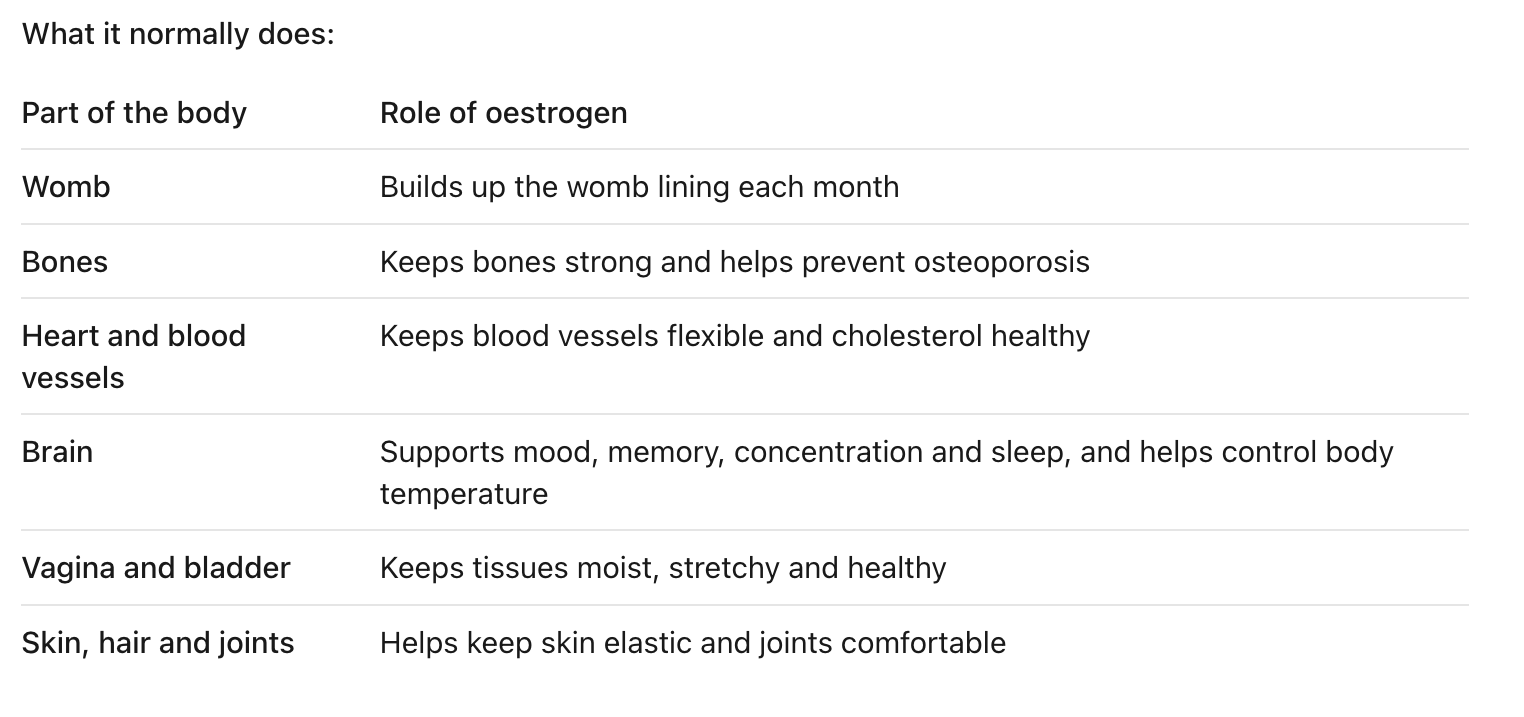
Oestrogen is the main hormone made by the ovaries, and it works throughout the body.
What happens in POI:
Oestrogen levels are low, or go up and down unpredictably.
This causes hot flushes, night sweats, vaginal dryness, poor sleep, mood changes and brain fog.
Over time, low oestrogen raises the risk of osteoporosis and heart disease.
HRT replaces oestrogen to ease symptoms and protect long-term health.
Progesterone
What it normally does:
Made after ovulation by the corpus luteum. This is the part of the follicle left behind once the egg has been released.
Prepares the womb lining for a possible pregnancy and stops it from growing too thick.
If pregnancy doesn’t happen, progesterone levels fall and this triggers a period.
Can affect mood and sleep. Some women find it calming, while others are sensitive to it.
What happens in POI:
Ovulation rarely happens, so progesterone is usually low or absent. This adds to irregular or missed periods.
Why this matters for HRT: if you take oestrogen on its own, the womb lining can thicken too much (endometrial hyperplasia), and over time this raises the risk of womb cancer. So if you still have your womb, HRT always includes progesterone or a similar hormone (a progestogen) to protect the lining.
Testosterone
Testosterone is often thought of as a “male” hormone, but women make it too, in smaller amounts. It comes from the ovaries and the adrenal glands, which sit on top of the kidneys.
What it normally does:
Supports sexual desire and arousal.
Contributes to muscle strength, bone health and energy.
Is used by the ovaries to make oestrogen.
May play a part in mood, concentration and wellbeing. Research on this is ongoing.
What happens in POI:
Testosterone levels may be lower, especially if both ovaries have been removed. Many women with POI still have normal levels, because the adrenal glands keep making it.
Low testosterone can contribute to low sex drive, and possibly to tiredness.
The 2024 guideline says testosterone may be considered for women with low sexual desire that’s causing distress, once oestrogen treatment is working well. There isn’t yet enough evidence to recommend it for energy, mood or bones.
DHEA, a related hormone sold as a supplement, is not recommended for POI.
AMH (anti-Müllerian hormone)
What it normally does:
Made by the small, growing follicles in the ovaries.
Gives an idea of how many eggs are left, often called the “ovarian reserve.”
Commonly measured in fertility clinics.
What happens in POI:
AMH is usually very low or undetectable, because few follicles remain.
AMH is not the main test for diagnosing POI. Results vary between laboratories, and a low AMH shows fewer eggs, not that the ovaries have stopped working. FSH is still the main test.
AMH can be helpful alongside a repeat FSH test when the diagnosis is uncertain, and it can give extra information when discussing fertility.
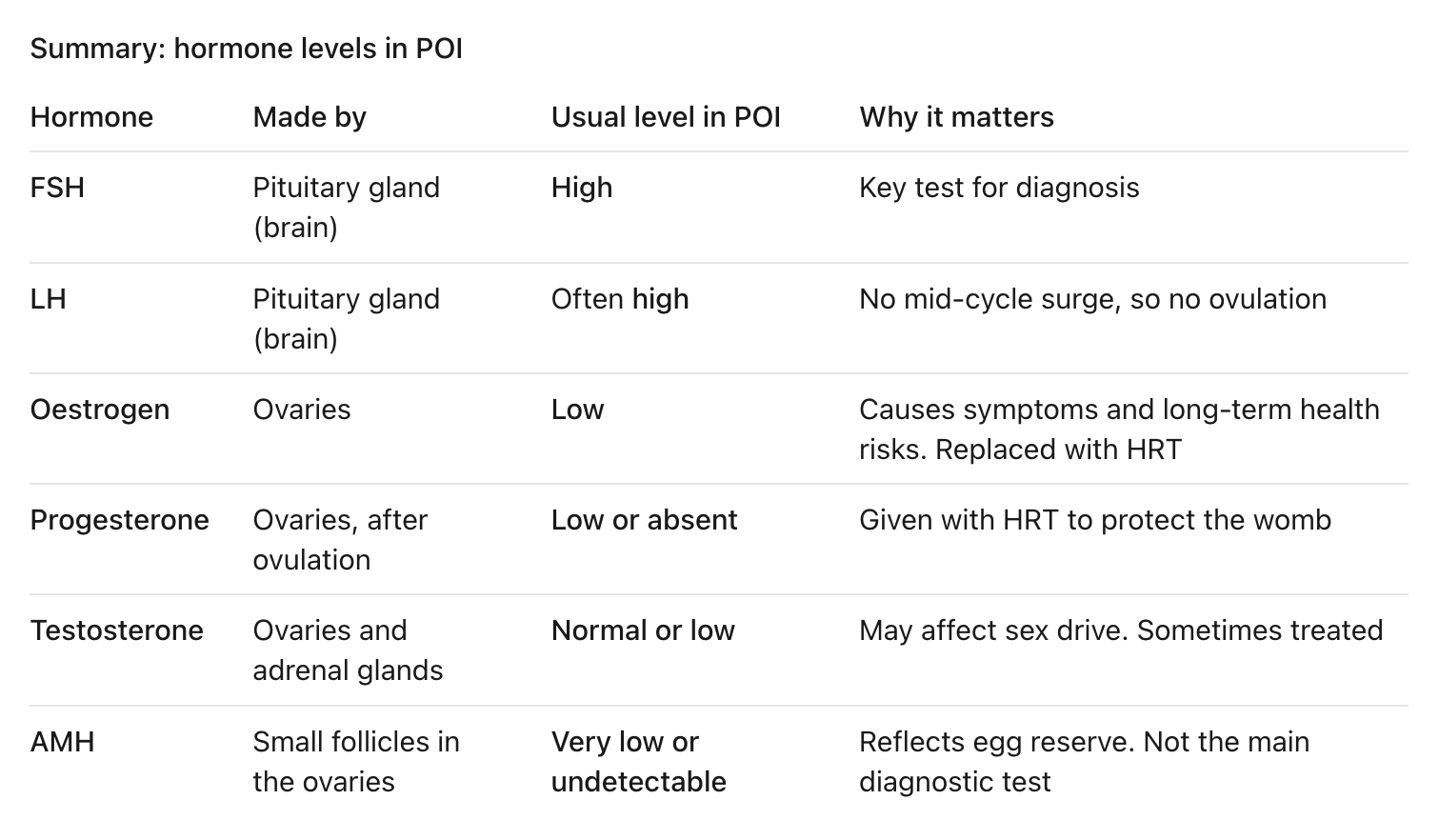
Summary: hormone levels in POI
Key messages
In POI, the ovaries make less oestrogen and progesterone, so the brain makes more FSH and LH to try to stimulate them.
A raised FSH (over 25 IU/L) is the key test for diagnosing POI.
Low oestrogen causes most symptoms and long-term health risks, which is why HRT is recommended until around 51.
Progestogen is added to HRT to protect the womb lining.
Testosterone may help low sex drive in some women. AMH gives extra information but isn’t the main test.
This information is for general education and does not replace personalised medical advice. Please talk to your doctor about your own hormone results and treatment.
Source: ESHRE Guideline Group on POI. Evidence-based guideline: premature ovarian insufficiency (2024 update). Human Reproduction Open, 2024.